| 2nd Annual Private Equity International Turkey Forum - September 22-23 |
| 28 July 2010 |
Finally pulling together all the major players in the Turkish private equity space last year (as reported on this site), it appears that EMPEA and PEI are doing it again - The 2nd Annual PEI Turkey Forum. This is really the largest "who's who" event that has ever happened in Turkey for this high potential space. (Dimiter, hope it worked out well for you last year.) I mean, look at this list of speakers:
- Amjad Ahmad, Senior Managing Director, Alternative Investments, NBK Capital
- Meltem Akol, Partner, White & Case
- Sarah Alexander, President, EMPEA
- Ozgur Altan, Investment Manager, European Investment Fund (EIF)
- Meltem Ankara, Senior Banker, European Bank for Reconstruction and Development (EBRD)
- Isak Antika, Co-Founder & Managing Partner, Actera Group
- Kathleen Bacon, Managing Director, HarbourVest
- Jean-Philippe Burcklen, Head of Lower Mid-Market, European Investment Fund (EIF)
- Dr. Mete Çakmakcı, Secretary General, Technology Development Foundation of Turkey
- Jennifer Choi, Director of Research, EMPEA
- Serkan Elden, Managing Director & CEO - Eurasia, PineBridge Investments
- Ercan Ergul, Managing Director, Bedminster Capital Management
- Mete Ikiz, Investment Director, NBGI Private Equity
- Tolga Işmen, Managing Partner, Ismen
- Ralph Jaeger, Senior Research Consultant, Cambridge Associates
- Amanda Janis, Senior Editor, Private Equity, PEI Media
- Yalin Karadogan, Principal, Cinven
- David Nieuwendijk, Senior Investment Officer Private Equity, FMO
- Murat Özgen, Chief Executive Officer, İş Private Equity
- Frank Roccogrande, Partner, Bilgili Holding
- Mehmet Sami, Executive Board Member, ATA Invest
- Selim Selimata, Manager - Project & Acquisition Finance, Garanti Bank
- Onur Takmak, Principal, RHEA Investments
- Seymur Tari, Managing Director, Turkven
- Sasha van de Water, Managing Director, Keyhaven Capital Partners
- Memet Yazıcı, Managing Director, Private Equity, Rhea Asset Management
- Selcuk Yorgancioglu, Executive Director & Turkey Country Head, Abraaj Capital
- Can Yucaoglu, Director, Turkven Real Estate
Incredible! Truly, what a great event this will be. While I can't imagine there is really that much to say about Turkey, the presence of such brain power and "pro-invest-Turkey" spirit will certainly be there. And it should be, because all tickets for institutional investors are FREE! (As is always the case at such events). Just curious, would anyone like to sponsor me to go to this event? I'd like to go. Maybe I could get a press pass? Hmmm....well anyway, let's hope this means that more inflow of private equity is able to enter Turkey and continue to grow this country to its potential.Labels: Conferences, PEI Turkey Forum, Private Equity, Serkan Elden, Seymur Tari
|
|
|
|
|
| Actera Group Closes Actera Partners Fund at $475 Million |
| 23 December 2007 |
 The Actera Group has finally closed their Actera Partners fund at over $475 million according to an AltAssets report. This would be a new Turkish fund record, and would most likely bring 2007 to a close with an increase in the private equity funding pool of over $1 billion.
Believe me when I tell you, I have seen a google search come from every country on this site, so Actera's reach has spread far and wide, whether it be through their road shows or due dilagence. Indeed, according to the statement, "commitments came from pension funds, multilateral institutions and sovereign wealth funds from North America, Europe, the Far East and the Middle East."
The main points of the statement include:
Actera Partners will focus primarily on buy-out and growth equity investments across various industry sectors in Turkey. In addition, the fund seeks to partner with Turkish companies to support their expansion to other countries.
The fund has already completed its first transaction. In partnership with US buy-out giant TPG it has invested in Turkish spirits company Mey Icki Sanayi.
 Isak Antika, managing partner and co-founder of Actera Group, said, 'Turkey is undergoing a fundamental transformation which is reshaping its economic landscape and underpinning its convergence with the developed economies of the world. Given the size of the Turkish economy, such convergence will result in substantial value creation opportunities.' Isak Antika, managing partner and co-founder of Actera Group, said, 'Turkey is undergoing a fundamental transformation which is reshaping its economic landscape and underpinning its convergence with the developed economies of the world. Given the size of the Turkish economy, such convergence will result in substantial value creation opportunities.'
So, congratulations go to the gentlemen operating Actera Partners, Isak Antika (of Antika Partners) and Murat Cavusoglu (previously of the George Soros SE Europe Fund/Bedminster Capital). Since starting the fund in early 2007, they truly have done a lot to promote Turkey to the rest of the world. Now, it is only a matter of time before we see more PE come to Turkey. Private equity in Turkey has finally started to blossom, and the world is finally taking note of the small-mid-large cap opportunities that are awaiting investment, especially as funds have continually gotten bigger. This still confirms a gap, and venture capital can only be next as one of Turkey's great potential opportunities that await investment.
For some more background on Actera and one of Grandstanding Traction's most popular posts, please visit, "New Turkish PE Fund by Actera Partners to welcome Canadian Pension Funds to Turkey"
The Actera Group website is still under construction.
 Technorati Tags: Private Equity, Isak Antika, Antika Partners, Deal Flow, Turkey, Murat Cavusoglu, Actera Partners Technorati Tags: Private Equity, Isak Antika, Antika Partners, Deal Flow, Turkey, Murat Cavusoglu, Actera PartnersLabels: Actera, Fund Closings, fundraising, Private Equity
|
|
|
|
|
| Turkven Closes Second Fund - TPEF II |
| 18 November 2007 |
 Although there is not a lot of information out there, it can be confirmed that Turkven has closed its second fund. Posted in October in the WSJ (for subscibers), the TPEF II buyout fund is predicted to be a whopping $428 million, "which is 10 times the size of its 1st fund which closed at $44 million in 2002".
For a Turkish private equity fund, this will be the largest increase in fund size ever achieved through a second fund raising. It is also interesting to note that with the crisis in 2001 and with the formation of their first fund in 2002, they may have had to overcome a currency crunch with some of their deals as well as reassurances to their LPs regarding Turkey's economic problems at the time. It's amazing to think that despite any negative issues that may or may have not occured, the demand for and outlook of Turkey has still kept investors and LPs positive. With this second fund closing, it appears that these volatile issues have passed. In addition, their relationship with Advent International will continue.
According to the International Finance Corporation (IFC) website and synopsis of the Turkven deal, their investment will comprise of some €20 million. This synopisis/project description/letter of intent is quite telling concerning Turkven's focus, strategy and relationship with the IFC. The IFC has been affiliated with Turkven since their first fund.
Finally, we come to what is officially stated on the Turkven website concerning the deal.
TURKISH PRIVATE EQUITY FUND II (2007)
TPEF II has commitments from over 15 global investors, who have invested in Turkven's strong track record and first mover status in the Turkish market.
So we know the IFC has committed €20 million and I can confirm that the EIF has committed €10 million as stated at the ÖDTÜ Entrepreneur Investor Summit in early November. With Turkven closing $400M+ and (according to Deloitte's PE in Turkey Report) Actera looking to close their second round at $400M+ with their fund this year (can we confirm AccessTurkey/iLab as well?), the Turkish private equity pool just got a lot larger. Once again, this proves the appetite for the Turkish PE deals and investment is very promising as conditions appear to be good. This also means we will see a lot happening in the small-mid cap buyout market in the next three years. I still must ask, "where is the venture space?" to fill the equity gap, but that is beside the point. Nonetheless, congratulations go to Turkven.
On a side note,
I would just like to say that Grandstanding Traction and myself are in no way affiliated with Turkven Private Equity. That should take care of any rumours regarding Turkvcanalyst. If you are interested in who I am, please drop me a line at: Turkvcanalyst(at)gmail(dot)com
Technorati Tags: Venture Capital, Turkven, Private Equity, Fund Closings, IFC, Turkey, EIFLabels: Fund Closings, fundraising, Private Equity, Turkven, Venture Capital
|
|
|
|
|
| Deloitte Touche Turkiye Publishes Most Comprehensive Turkish Private Equity and Venture Capital Reports - 2007 |
| 11 November 2007 |
 A few people were looking for the link to this report on my freind Kutlu's blog on Entrepreneurship. So, for anyone curious about testing the waters of the PE/VC space in Turkey, the Deloitte Touche Turkiye report on Private Equity in Turkey (PDF) is a must-read. With the Turkish Venture Capital Association being non-existant (the last analysis being written in 2004), and TUSIAD being focused in other areas, this report from Deloitte Corporate Finance is the most comprehensive analysis to date. Originally I found this report on the Turkish US Business Council website (with some other good reports), but here is the real home link at DT:
The report is structured around various economical periods in the last 20 years dealing with crises as well as telling of various fundraisings, deals and exits. It is a white paper of course, so the conclusion leaves the reader with information how to contact Deloitte Corporate Finace Turkey for their consulting and M&A requirements.
One cannot argue with the appendix. It is a timeline of all deals and a valuable resource. However, as mentioned in the report, some deals and their values are estimates only and should be taken with a grain of salt. In addition, there is a feeling that data collected comes only from personal experiences and local speculators with contacts in the deals themselves. I also believe that a few academics were involved on the consulting work for this report. Once again, I will reiterate that it is a shame that the TVCA has not produced anything that resembles this study.
Deloitte should be applauded for this work. Furthermore, while I provide the link for this report, I feel that I should also provide links to two other fine DT reports of noteworthy respect.
Enjoy!
Technorati Tags: Venture Capital, Reporting, Deal Flow, Turkey, entrepreneurship, Private Equity, Deloitte ToucheLabels: Deloitte Touche, Investment Reports, Private Equity, private equity research, Technology, Venture Capital
|
|
|
|
|
| Blue Voyage Partners Exit AFM Cinemas |
| 04 November 2007 |
As posted in the TDN (Velios buys AFM’s 51.9 percent shares), it appears AIG Blue Voyage achieves an exit from one of their longtime investments after just re-entering Turkey. I'm a bit short of time as of late, so here are the main points from the article:

 Turkish cinema company AFM sold more than 50 percent of its shares to the Velios Ltd., a subsidiary of Russian Alfa Group Consortium Tuesday evening. The estimated price of the shares is to be around $28.5 million, however, the final price will be set after closing. Turkish cinema company AFM sold more than 50 percent of its shares to the Velios Ltd., a subsidiary of Russian Alfa Group Consortium Tuesday evening. The estimated price of the shares is to be around $28.5 million, however, the final price will be set after closing.
This led the previous owners of the company, Akdemir family and AIG Blue Voyage Fund L.P., to sell all their shares except for the 10 percent belonging to Ahmet Adnan Akdemir, AFM founder.
A statement made to the Istanbul Stock Exchange (IMKB) said that 51.9 percent of AFM shares (owned by AIG Blue Voyage Fund L.P., Yalçın Selgur, Mehmet Berent Akdemir, M. Sedat Akdemir, Fatma Füsun Akdemir, Ahmet Adnan Akdemir and Yusuf Agah Tansev) were sold to Velios Ltd. for $28.5 million.
AFM's market value
"The market value of the company is around $59 million but for the deal we calculated it to be $55 million. $28.5 million is not the final price, it may change after closing agreements," CEO Akdemir said yesterday.
Ahmet Adnan Akdemir remained a shareholder of the company with 10 percent. "I am also going to remain in his position as the CEO of AFM Sinemacılık for at least two more years," he added.
The deal also included an optional arrangement providing that Ahmet Adnan Akdemir's remaining shares will not be able to purchased within a year but later they will also be open to a sales agreement between two parties.
 Alfa Group is a Russian consortium that is operating on many different business areas, including financial services, oil and gas production, technology, retail trade, telecommunications and media. The consortium is known in Turkey for its investment on Turkish GSM operator Turkcell. As of April 2007, the group together with its telecommunications subsidiary Altimo holds 27 percent of Turkcell shares. Alfa Group is a Russian consortium that is operating on many different business areas, including financial services, oil and gas production, technology, retail trade, telecommunications and media. The consortium is known in Turkey for its investment on Turkish GSM operator Turkcell. As of April 2007, the group together with its telecommunications subsidiary Altimo holds 27 percent of Turkcell shares.
AFM is Turkey's nationwide largest cinema circuit with 183 screens around the country and the first and only entertainment company listed in İMKB since October 2004. Close to 38 percent of the company shares are offered publicly and 90 percent of these publicly offered shares are owned by foreign firms such as Morgan Stanley.
AFM is expected to continually expand, especially with this new Russian partner, and a burgeoning shopping center boom in Turkey. I find it interesting (and a coincidence?) that just my last post was regarding the AIG Blue Voyage Fund (AIG Rehires and Re-Enters Turkish Buyout Market with Blue Voyage Advisors). It can only be speculated that the rehires and Blue Voyage's resurgence back in Turkey may have been tipped off by the momentum of this deal.
AIG originally bought a minority holding into AFM for an estimated $7 million in 2000. Again, we can only speculate on their rate of return (if any) on this deal, since there are others involved in the exit.
Technorati Tags: AIG, Blue Voyage Fund, Private Equity, Investments, Deal Flow, Turkey, Buyout, Alfa Group, Venture Capital, exitsLabels: AIG, Alfa Group, Blue Voyage Fund, Buyout, exits, Investments, Private Equity, Turkey, Venture Capital
|
|
|
|
|
| AIG Rehires and Re-Enters Turkish Buyout Market with Blue Voyage Advisors |
| 21 October 2007 |
 According to the Wall Street Journal, AIG is again making a push to enter the Turkish buyout/venture space. Setup in 2000, the AIG Blue Voyage Fund was a $100m (€72m) fund dedicated to private equity investing in Turkey.
Of course you may remember that those were tough times to put together a fund {with the country nearing elections, the 2001 crisis, and the devaluation of the lira}. Nonetheless, the spirit of putting together a private equity fund in Turkey was commendable and they were able to make three acquisitions of companies in the consumer and entertainment sectors which included AFM Theaters and Galatasary Sportif by 2004. Perhaps it was the trouble with board member shifts at Galatasaray that made them lose heart? Even so, the fund deliberately slowed its investment pace from 2002 to 2004 and by 2005, the fund closed with only 30% of its capital committed. Aside from Blue Voyage, however, last year AIG Capital was able to regain some ground in Turkey, taking a stake in For You, a discount fashion retailer with branches across the country.
Well, that was then and this is now. Serkan Elden, who spent six years setting up AIG's business in Southeast Europe, has been rehired to fill the post of president and chief executive for Blue Voyage Advisors. He will also be given the title of managing director of AIG Capital Partners, and will be responsible for boosting the firm's investment activity in Turkey. Elden originally left AIG Blue Voyage in 2004 to setup his own boutique investment advisory firm, 3 Seas Capital Partners, a firm that still exists today. From there, he became chief executive of Fintur Holdings BV, a joint venture of Turkcell and TeliaSonera, and a provider of mobile telecommunication networks servicing Azerbaijan, Kazakhstan, Georgia and Moldova.
So, per my last post regarding KKR's acquisition of UN Ro-Ro, and re-emergence of the AIG Blue Voyage Fund, it is interesting to note the direction of the trend. Again, we will have to wait and see who in Turkey is ready for the next buyout deal, and who will enter next.
For future reference, all of these Turkish funds and PE firms can be found in the PE/VC Index in the left sidebar.
Technorati Tags: AIG, Blue Voyage Fund, Private Equity, Investments, Deal Flow, Turkey, Buyout, Southeastern Europe, Venture CapitalLabels: AIG, Blue Voyage Fund, Buyout, Investments, Private Equity, Southeastern Europe, Turkey, Venture Capital
|
|
|
|
|
| KKR Makes First and Largest PE Investment in Turkey |
| 14 October 2007 |

 In September, some suprising news came out that KKR (Kohlberg Kravis Roberts & Co) was attempting a takeover bid for the Turkish UN Ro-Ro shipping firm. Well, news has just been released coutesy of Reuters (KKR buys 98 pct of Turk shipper in $1.28 bln deal) and Forbes (KKR Ro-Ros To Turkey) that the deal has gone through. KKR will purchase a 97.6% stake worth 882.2 million euros ($1.2 billion) from the consortium of international shippers. While this may pose as a landmark deal for private equity enthusiasts such as myself, not to mention the largest private equity deal ever to be done in Turkey, KKR first appeared to have bitten off more than they could chew. In September, there was negative speculation both from Chairman Saffet Ulusoy (who said that he would never sell) and the Turkish Armed forces as to the selling-off of national security interests.
 UN Ro-Ro, a roll-on/roll-off shipping company, owns 9 ships and was founded in 1993 during the Yugoslav-Balkans War - a war that closed overland shipping routes connecting Turkey and Europe. The ships sail daily from the port of Ambarli-Pendik, Turkey carrying lorries and container vehicles filled with Turkish goods to Trieste, Italy. UN Ro-Ro, a roll-on/roll-off shipping company, owns 9 ships and was founded in 1993 during the Yugoslav-Balkans War - a war that closed overland shipping routes connecting Turkey and Europe. The ships sail daily from the port of Ambarli-Pendik, Turkey carrying lorries and container vehicles filled with Turkish goods to Trieste, Italy.
Speaking on the deal, KKR's John Pfeffer commented, "We believe in the growth of trade between Turkey and Europe and U.N Ro-Ro’s important role in that development. We are very interested in the Turkish market and believe that private equity can play a helpful role by investing to support the growth of businesses. This is our first investment here, and we hope to find other investment opportunities in the future."
On one hand, this type of deal with a large private equity player coming to Turkey was inevitable. The economy is still holding on, the elections are over, and Southeastern Europe funds have been circling around Turkey for quite some time now. The Forbes article makes an interesting comment concerning the increased desire for private equity deals in emerging markets due the "lack of appetite for credit to finance more expensive acquisitions in developed markets."
On the other hand, Golden tier US funds are currently on the fence and gaming to set up new offices or affiliates in Europe. For example, DFJ has bought a stake in European Esprit Capital Partners and has also just launched a VC fund in Russia. In addition, AIG has made motions and new hires to launch back into Turkey (more on that later). It seems even with the bubble bursting 7 years ago in the US, and with different cultures between US and European private equity deals, the US funds are willing to give it another go. It should be interesting to see if Europeans are still open to the idea and which firm will be next.
But for Turkey, this large scale private equity deal should send signals to other large international players and make them take note. The advantage will remain with those firms (both legal and consulting) on the ground in Turkey that have the resources to spot and get the deals, not to mention the large Turkish firms with buyout potential.
Technorati Tags: KKR, DFJ, Private Equity, Investments, Deal Flow, Turkey, UN Ro-Ro, Takeovers, Shipping, AcquisitionsLabels: Buyout, deal flow, DFJ, Emerging Markets, KKR, Private Equity, Shipping, Takeovers
|
|
|
|
|
| EVCA Releases Quarterly Report: Median Venture Investment Surpasses €3 million |
| 17 September 2007 |
 At the end of August, the European Venture Capital Association produced its quarterly report with the help of Dow Jones, VentureOne, and Ernst & Young. The highlight of the report, published here by AltAssets, is that European venture capital investment reached €1.14bn in Q2 2007 despite a drop in deal flow to 213 in Q2 2007 from 223 in Q1 and 265 in the same period last year.
While great news for investors and entrepreneurs in Europe with a venture model coming of age, the real story should be next quarters results to understand if the markets and appetite for investments remained confident after the credit fluctuations in the US and abroad. Surely the investing of private equity funds in this stage of the cycle does not stop investors from investing funds in smart companies. As of yet, we still have not seen any stagnation in fundraising either. As well, what IRRs these funds will be gaining is another area of interest in the years to come.
But I think what is most striking about this report is that the median size of venture investment round has surpassed €3 million. Here is an excerpt from the report that is most telling about this:
'The European venture capital market saw an explosion in early-round investing as €600m was poured into 126 early stage deals,' said Jessica Canning, director of global research for Dow Jones VentureOne. 'The data shows the median amount invested in a first round during the quarter was €3.2m, by far the highest total on record. Add to that a continued interest in later stage deals and the overall median for a deal done in Europe jumped 41 per cent during the second quarter to a record €3.1m.'
'The record median round size in Europe this quarter is the continuation of a trend that we have observed over the last 18 months in which investors are providing greater sums to fewer companies, allowing those companies to better compete globally and build critical mass for an IPO or M&A,' added John De Yonge, research director for the Ernst & Young Global Venture Capital Advisory Group.
Buyout funds around the world are setting records in fundraising. For example; see how Carlyle has just closed its Carlyle Europe Partners III out at a cool $7 billion. While some VCs in Silicon Valley are even complaining that the VC model is broken, some even giving money back to LPs (Sevin Rosen), we have to pause and wonder "Where is the venture model going?" Research has proven that with increased fund sizes comes increased median investment sizes and increased valuations of investments whether inflated or not, and increaing acquisition prices. The decreasing number of investments could be considered direct support for the "Venture Capital Model is Broken" Theory, and is definitely cause for concern. We have all talked about the "Funding Gap" that exists between Seed and Incubation Investment and Series A. Are we reaching a stage where incubated companies will only have banks (or possibly angels) to turn to? What should fill this gap is the true venture model.
And for Turkey, firstly we should be concerned how much of the EVCA number includes Turkey if any. We should also be concerned about the outliers in the data that constitute venture. Secondly, since the Turkish government has pinned "so much" investment toward the building of incubator science and technoparks, we must ponder about our incubated companies who will simply not make the cut when looking for that venture financing. The foci of Turkish Venture Funds is still fairly traditional - technology (with some stipulations). And if the median investment round is to increase - what then? The funding gap has just gotten larger...
Finally, once again, I'm going to send a shout out to the Turkish Venture Capital Assocation (if there is one) that is actually registered with the EVCA, and challenge them, "Where is the data?" I'm willing to work with you here. Would someone at the EVCA give them a call, please? Maybe the fault does not lie with the TVCA, but rather the reluctance of Turkish VCs toward paying dues and continuing the work of the TVCA! If you want to set the record straight on this, I urge the TVCA, the EVCA or any Turkish VC to contact this site, or comment below.
Technorati Tags: Venture Capital, EVCA, TVCA, Quarterly Report, Deal Flow, Turkey, entrepreneurship, Incubation, innovation, Funding Gap, incubator, VCLabels: EVCA, Funding Gap, fundraising, Incubators, Investment Reports, Median Investments, Private Equity, private equity research, TVCA
|
|
|
|
|
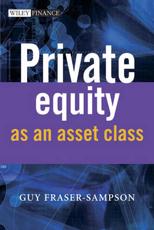
| REVIEW: Private Equity as an Asset Class by Guy Fraser-Sampson |
| 05 August 2007 |
  To the average man on the street, the world of private equity can take on a perception of big-men-banker types, cigar smoke-filled boardrooms and ivory towers. However, Guy Fraser-Sampson's new book, Private Equity as an Asset Class, puts a face of the common man to private equity that makes it an easy (and enjoyable) read for students of finance, PE/VC professionals, pensioners, gatekeepers and first-time investors.
For the private equity industry, the writing of this book was sorely needed. Guy Fraser-Sampson is the right man for the job - a man with 20+ years of PE experience and previously a partner and managing director at Horsley Bridge. It has just gone on sale in the United States and sold over 1000 copies in the first 10 weeks in Europe. When first I was sent his book, I was delighted. It has been described as "the only definitive text book in the world on private equity." After reading it, I can honestly say it will provide a benchmark and turning point for the global PE industry for years to come. Guy Fraser-Sampson has hit a home-run (pun intended).
Private Equity as an Asset Class follows his first book, Multi Asset Class Investment Strategy, which went into the Amazon "Hot 100" six weeks after launch and has been hailed as a major contribution to modern portfolio theory. With the objective of answering the question, "What is Private Equity?", Guy Fraser-Sampson does just that with a straight-forward, "common-sensed" approach - making this the most up-to-date tome on the PE/VC asset class investment model and an ideal textbook. Because of this, it provides an excellent template for future abridged editions, if the writer later feels so inclined.
In addition, the author makes good use of data compiled from Thomson Financial's VentureExpert bringing to the reader the most recent comparisons of the European and US PE/VC space. There is an excellent glossary and clarification of terms for the PE industry such as Internal Rate of Return (IRR) and Multiples. This also includes a breakdown of the similarities and difference between the venture and buyout spaces - by the sizes of funds, received returns and vintage years. Guy Fraser-Sampson takes this data, combines it with his experience at Horsley Bridge and provides possible reasons for the results and an inside look at the world of private equity. Some other key points that the reader can take away are:
- For academics and students of finance: It provides the basics of mathematical and financial formulas that can be used as a springboard for continued reading and research of other PE/VC academic papers in circulation.
- For Venture Capitalists and PE professionals: The book stresses (and proves) the need for a "home-run mentality" when making investments. From Horsley Bridge's (now famous) data on home-run selection, a home-run can represent only 5% of a venture fund's cost, but also represent 80% of total returns for a fund! Thus the mindset and the search for more Googles and YouTubes is mandatory for a successful fund. In addition, the data concerning fund sizes versus returns provides an excellent picture of a perceived "sweet spot" for optimal fund size with maximum return for investors.
- For first-time PE/VC LPs and pension fund investors: The book is an accurate guide toward the development of a PE investment program and allocation of capital. It also provides a lecture on how IRR, multiples and a "Total Return" method are the only true ways to analyze prospective PE/VC funds. The idea of budgeting, measuring and analyzing compound annual returns of a PE/VC fund is simply impossible and therefore foolish.
If I were to provide some negative qualities of the book, I can only say that in some cases, the author defers discussion of certain areas as "needing a book of its own" where the reader may have preferred more discussion. Some sections of chapters do not read like a textbook, but rather like an editorial column or a novel. Where simplicity was attempted and with added real-life examples, it is here that perhaps more elaboration was needed.
To add to this, (and this is by far no fault of Guy Fraser-Sampson), the European data gleaned from Thomson Financial's VentureExpert is riddled with badly categorized outliers. It is an analytical tool filled with holes. Mr. Fraser-Sampson makes a note of this as "rather overzealous research on Thomson's part as well as some PE/VC organizations too enthusiastic for inclusion in the database". The reader is made aware of these sections. Therefore, some of Mr. Fraser-Sampson's results and analyses are speculations (although sound) based on his years of experience. If anything, this should be a wake-up call to Thomson Financial to get its house in order.
Despite this, Private Equity as an Asset Class is a welcome addition to anyone's finance library. As it is using the most recent data, PE professionals would be negligent not having it as a reference. For Pension Fund professionals and investors, it is a must-read, because it nearly is a "first" of its kind. So before you dive into those boring journals of master's theses and conference papers, you should pick up this book.
For questions about this review, please email me at turkvcanalyst@gmail.com. If Amazon is unable to deliver to your country, go to your nearest bookstore and order it (in Turkey, via Remzi or D&R).
Technorati Tags: Private Equity as an Asset Class, Guy Fraser-Sampson, Venture Capital, Private Equity, Book Review, Pension Funds, investment, US Data, European Data, VCLabels: book reveiw, European Data, Investment, Pension Funds, Private Equity, US Data, Venture Capital
|
|
|
|
|
| A New Entry in the Turkish Venture Capital Space: Delta Capital Interested in Turkish Telecom Companies |
| 20 July 2007 |
 In March 2007, Delta Capital, a Private Equity firm focused in the telecom industry in the Middle East and Africa, closed its MENA Telecom Fund, raising over 75 million USD. Conceived and headquartered in Dubai UAE, Delta Capital is part of Delta Partners - a company with strong expertise in the telecom industry.
According to the Delta Partners website, the fund will have a life of 7 years with an investment period of 3 years. In addition, unlike most VC funds that are constrained to a certain region, Delta has chosen a wide path - the MENA region. What is exciting about this is that it includes Turkey!
Over a conference call, I spoke with Delta Capital. I asked them to send me a few comments and answer a few questions about their fund. The following is a representation of that conversation according to Delta Capital's Head of Private Equity, Morten Kvammen:
"Why do you wish to invest in Turkey? Why now?"
Turkey, having a liberalised telecom industry and a continuously growing economy, is one the top priority countries for Delta Capital to invest in. With increasing competition amongst mobile operators and long distance telephony service providers, the Turkish telecom market has started to grow rapidly, proving to be one of the most thriving emerging market in the region. Thus, Delta Capital believes there is a great growth potential for companies in the Turkish telecom value chain.
"What kind of companies are you looking for?"
Delta Capital is currently looking for companies with operations in the Telecommunications value chain (from Network infrastrucure players to retail & distribution) that are looking for potential investors in order to achieve their goals. These companies should have their operations in the MENA region including Turkey, should be running a established business with demonstrated success, and with exceptional growth potential. The potential investee companies are expected to have developed an insightful and comprehensive Business Plan that describes the continuity of the high growth. Thanks to the unique structure of Delta Capital and Delta Partners, the MENA Telecom Fund is willing to provide growth capital and can leverage its telecom expertise to help in the expansion of the associated business.
"What will Delta Partners bring to the table?"
The Advisory side of Delta Partners offers strategy consulting to the main telecom players in the region, and has a solid team of more than 70 experienced professionals of 22 different nationalities, creating strong synergies with the Private Equity business. Delta Capital’s unique approach of combining a solid team with in-depth knowledge in the Private Equity business, together with top-notch intellectual capital from the Advisory side, and relevant contacts, makes it quite attractive to companies looking for partners to succeed and attain their growth objectives.
So, for all prospective entrepreneurs and companies that fit their focus - this is a great new opportunity for Turkey. I urge you to submit your business plans to Pipeline@deltapartnersgroup.com, or contact Delta Capital directly.
For any questions about this particular post, please contact turkvcanalyst@gmail.com.
Technorati Tags: Venture Capital, Delta Partners Group, Delta Capital, Fund Closings, Deal Flow, Turkey, Morten Kvammen, Delta Partners Group, MENA, Entrepreneurship, Telecom Industry, Dubai
Labels: Dubai, Entrepreneurship, Fund Closings, MENA, Private Equity, Telecom, Venture Capital
|
|
|
|
|
| The Shopping Center Boom in Turkey |
| 01 April 2007 |
The beginning of 2007 has been marked by some notable entries into the Turkish market: foreign investment into Turkish shopping centers. According to an article in the TDN in February quoting a WSJ article, "prime shopping centers offer yields of around 8 percent to 9 percent. Investors buying shopping centers before they are completed hope for yields of 10 percent to 11 percent." I would venture to guess that ROI’s are very much in the teens when it comes to Turkey’s current environment, hence the future demand. (Corio’s Real Estate Investment Fund expects a 5-year return of 20%!)
 In another example, Andrew Finkel writes in Today’s Zaman that, "the new Kanyon shopping mall designed by Venice Beach headquartered Jerde Associates is now estimated to be worth three times its $200 million ticket price." Aside from these numbers, the rush towards investment can be attributed to one important statistical comparison: Turkey has just 30.4 square meters of retail space per 1,000 people, a fraction of the European Union average of 171.1 square meters, according to advisory firm Cushman & Wakefield Inc. In another example, Andrew Finkel writes in Today’s Zaman that, "the new Kanyon shopping mall designed by Venice Beach headquartered Jerde Associates is now estimated to be worth three times its $200 million ticket price." Aside from these numbers, the rush towards investment can be attributed to one important statistical comparison: Turkey has just 30.4 square meters of retail space per 1,000 people, a fraction of the European Union average of 171.1 square meters, according to advisory firm Cushman & Wakefield Inc.
In addition, the WSJ goes on to state that about 3 billion euros to 4 billion euros ($3.9 billion to $5.2 billion) of real estate deals are expected to be transacted in Turkey this year. This compares with about 1.1 billion euros in deals last year, which, in turn, represented a tenfold increase from 2004.
Recent entries, acquistions and investments are as follows:
- 14th, February 2007 - Citigroup Venture Capital is in talks to buy stakes in two of Turkey's leading retail chains, Boyner and Beyman, in a deal that highlights the growing interest of private equity groups in acquiring Turkish assets.
The Boyner family, an Istanbul-based business dynasty, said in February that its holding companies had entered into exclusive talks on selling stakes in Boyner Department Stores and Beymen, a luxury goods chain, to CVCI in a deal that could value them at $450m.
Boyner said the family believed it was the right time to sell. "It gives the holding company liquidity at a time when there are lots of opportunities in the market," she said.
Under the terms of the proposed deal, CVCI will buy 30 per cent of Boyner and 50 per cent of Beymen.
The largest private equity deal so far in Turkey was Texas Pacific Group's investment in Mey, a local beverage group. TPG purchased 90 per cent of the company last year in a transaction that valued Mey at $900m.
- 5th, October 2006 - Merrill Lynch in partnership with İstanbul-based Krea Real Estate made its first real estate investment with 50 percent share of the Neo Shopping Mall in Eskişehir.
Merrill Lynch is hoping to acquire 100%. According to Merrill Lynch Turkey Global Markets and Investment Banking head Kubilay Cinemre, "Here we have a business capacity of $1 billion," referencing both commercial and housing projects.
- 15th, November 2006 - Cevahir Mall, Europe’s largest shopping centre acquired by St. Martins Property.
St Martins Property, part of the Kuwait Investment Authority, has purchased Europe's largest shopping centre, Cevahir, in Istanbul for a sum in the region of $750 million from its joint owners, the İstanbul Municipality and the Cevahir family.
- 23rd, January 2007 - VastNed Retail buys Turkish shopping center.
Dutch based pan-European retail property investor VastNed Retail enters Turkey by acquiring a neighbourhood shopping centre in Istanbul at a price of €9.7 million. The shopping center is located on Kazim Orbay street, Sisli, Istanbul and is called Elysium Shops. This neighbourhood shopping centre is newly built and comprises 4,850 ²m of retail space and 200 parking spaces.
In the area of Contract Management firms and Consultants:
For Dutch property group, Corio, who paid a benchmark $192 million for an initial 46.9% stake in the nearby Akmerkez mall in a 2005 public offering, the shopping center boom of Turkey seems to have fit into their plans.
- 9th, February 2007 - Corio purchases 40% interest in Turkish shopping center.
Corio has announced the acquisition of a 40% interest in Teras Park shopping center currently under development in Denizli, in the south west of Turkey, for an amount of approximately €55 million.
- 2nd, March 2007 - Two more Acquisitions for Corio in Turkey
Corio, one of the largest listed property investment companies in Europe, said it would acquire the Adacenter shopping center currently under development in the northwestern city of Adapazarı, Turkey for about $65 million. In addition, the property developer said it will also take a 7 percent stake in "potentially large scale" project Acıbadem, to be developed in Istanbul.
- 21st, March 2007 - Corio has signed an agreement for the acquisition of a 50%-interest in Esenyurt shopping center currently under development in the Esenyurt district on the European side of Istanbul for a total amount of approx. €42 million (US$60m).
On a final note, I’ll leave you with some slides to ponder from Corio’s Andre Van den Berg’s presentation to Ak Yatirim in January 2007. His model of Turkey being in the center of the development cycle is very telling for what still is to come, and as you can see by the statistics of plans under development, it doesn’t look like it will be slowing down anytime soon. He also leaves a final concern: the need for strict planning policies in the public administrations. Istanbul does have the potential to overbuild without regulating infrastructure and legal framework and this can be worrisome. Very poignant indeed.


For further reading:
Technorati Tags: Shopping Centers, Venture Capital, Private Equity, Acquisitions, Deal Flow, Turkey, emerging markets, Turkish, Corio, REIT, Citigroup, Boyner, Beymen, Merrill Lynch, KREA Real Estate, Kubilay Cinemre, St. Martins Property, Cevahir, VastNed Retail, VC, Donaldsons, Jones Lang LaSalle, Andre Van den Berg, Ak Yatirim, Akmerkez, KanyonLabels: acquisitions, deal flow, Emerging Markets, Private Equity, Shopping Centers, Turkey, Venture Capital
|
|
|
|
|
|
|
|
|




 Publisher: Jon H. Black